
Teambuilding III: Optimize & Tech
The advanced teambuilding layer for Reg M-B: win-condition-first building, stat-point spread optimization for speed tiers and bulk benchmarks, flex/tech slots for the meta, and reading usage + the tier list to adapt.
Last updated · evergreen, updated as the meta evolves
At the advanced level, teambuilding is optimization: every stat point, every item, and every tech move earns its place by hitting a specific benchmark against the *current* meta. This guide covers win-condition-first building, spread optimization, flex slots, and how to read usage data and the tier list to adapt.
Win-condition-first building
Advanced builders don’t start with "six good Pokémon." They start with the exact way they intend to win and reverse-engineer the team from it. Decide: *my win condition is a +2 Kingambit cleaning with Sucker Punch.* Now every other slot exists to make that happen: the speed control that lets it move, the support that buys its setup turn, the answers to the Pokémon that would revenge-kill it. When every slot serves the win-con, the team has a spine.
Stat-point spread optimization
Dumping two maxed stats (32/32) is fine for a first team, but optimized spreads spend your 66 points on benchmarks, not raw stats. Two questions drive every spread: what speed tier do I need to hit (out-speed X, or under-speed for Trick Room), and what bulk benchmark do I need to survive (live a specific attack, then heal or hit back)? Everything left over goes into offense. The result is a Pokémon tuned for real matchups, not raw numbers.
| Question | What it decides | Example benchmark |
|---|---|---|
| What must I out-speed? | Speed points (or a Scarf) | Out-speed max-Speed Garchomp by 1 point |
| What must I survive? | HP + defense points | Live a Life Orb Draco Meteor, then Sitrus-heal |
| What must I OHKO? | Attacking points + nature | Max Atk (32) + boosting nature to guarantee the KO on the target |
| Trick Room mon? | 0 Speed points + a Speed-lowering nature | Under-speed everything to move first under TR |
| Stat points | Buys | The reason |
|---|---|---|
| 32 HP | Maximum raw bulk | More HP makes every defensive point and its Chople Berry worth more |
| 24 Atk | Guaranteed OHKOs on its targets | Enough to KO the frail threats without maxing Attack |
| 3 Def | Odd-HP / rounding tweaks | Small leftover into its better defensive side |
| 7 Spe | Creeps other slow attackers | Under-speeds fast mons on purpose, out-speeds the base-50 mirror |
The table above is the whole idea: instead of "32 Atk / 32 HP," every number ties to a calc: "24 Atk guarantees the KO," "7 Spe wins the mirror." When you can explain each stat point, you have a *reason*, not just a spread. Check every line in the damage calculator before you lock it.
Speed-tier benchmarking
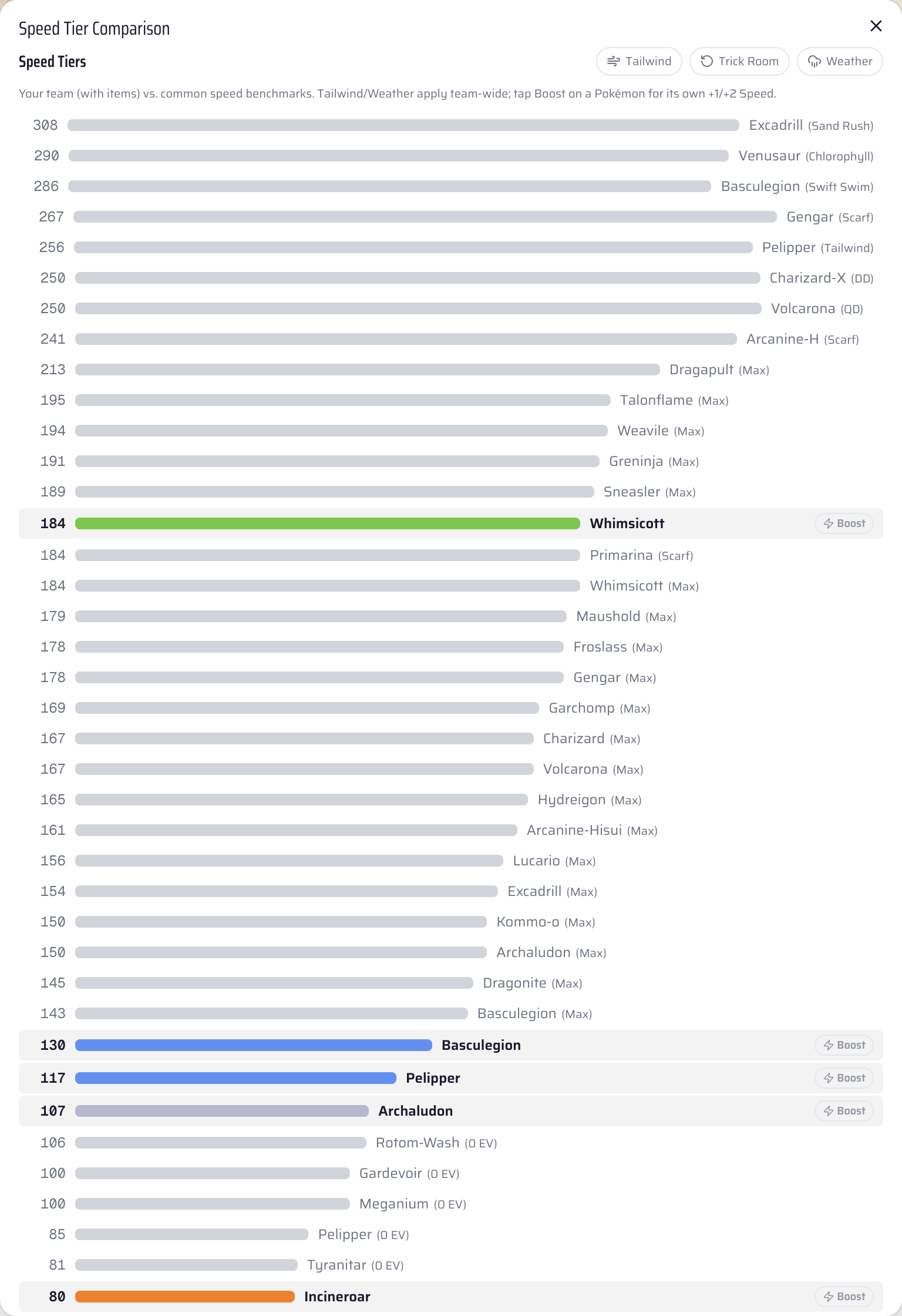
Speed is the benchmark you tune first, because moving first decides everything else. At Level 50 every stat is a fixed number, so you can target an *exact* Speed. The table below lists the real Lv50 max Speeds of the key Reg M-B Pokémon. Memorise the ones near your attackers, then invest just enough to sit one point above the threat you must out-speed (or, for Trick Room, minimise Speed to sit below everything).
| Pokémon | Base | Max Speed (Lv50) | Neutral max (no +nature) |
|---|---|---|---|
 Aerodactyl-Mega Aerodactyl-Mega | 150 | 222 | 202 |
 Dragapult Dragapult | 142 | 213 | 194 |
 Sneasler Sneasler | 120 | 189 | 172 |
 Whimsicott Whimsicott | 116 | 184 | 168 |
 Lycanroc-Dusk Lycanroc-Dusk | 110 | 178 | 162 |
 Garchomp Garchomp | 102 | 169 | 154 |
 Charizard-Mega-Y Charizard-Mega-Y | 100 | 167 | 152 |
 Archaludon Archaludon | 85 | 150 | 137 |
 Basculegion Basculegion | 78 | 143 (286 in rain) | 130 |
Say your Garchomp must win the mirror against other max-Speed Garchomp (169). Running one extra Speed point puts you at 170, so you out-speed every "standard" Garchomp by one and win the mirror outright. The whole art of a Speed point is finding the number just above the threat you fear, then dumping the rest into bulk or offense. Confirm every line in the damage calculator.
Defensive backbones: the bulk that holds a team
Offense wins turns; a defensive backbone wins games you’d otherwise lose. A backbone is one or two bulky Pokémon whose typing and bulk absorb the format’s scariest hits and reset momentum: think Incineroar (Intimidate + pivot), a bulky Water like Milotic or Rotom-Wash, or a Steel like Archaludon or Corviknight. When your offense stalls, the backbone is what keeps you in the game long enough to find a new line.
| Backbone | Typing | Absorbs / resets | Legal set note |
|---|---|---|---|
 Incineroar Incineroar | FireDark | Physical attackers (Intimidate) + pivots out | Sitrus + Fake Out / Parting Shot |
 Milotic Milotic | Water | Special + physical; Competitive punishes Intimidate | Flip Turn / Icy Wind / Recover |
 Toxapex Toxapex | PoisonWater | Nearly everything; Regenerator heals on pivot | Recover / Toxic / Haze / Baneful Bunker |
| Archaludon | SteelDragon | Physical hits (130 Def) + rain sweeper | Electro Shot / Flash Cannon / Dragon Pulse / Protect |
 Corviknight Corviknight | FlyingSteel | Physical hits + Roost longevity | Brave Bird / Body Press / Roost |
Flex / tech slots for the meta
Most of your team is fixed by its plan, but one or two flex slots and a tech move or two exist purely to beat what’s popular *right now*. Facing a lot of rain? A Water-resist berry or your own weather answer. Trick Room everywhere? A Taunt user or Imprison. Tech is how the same core stays live as the meta shifts: you change the flex, not the spine.
| Threat you’re teching against | Tech answer | Legal user / item |
|---|---|---|
| Rain (Pelipper + sweepers) | Your own weather to overwrite it, or a Water-resist wall | Charizard-Mega-Y (sun)Archaludon |
| Trick Room setters | Taunt (ideally Prankster) or a fast KO on the setter |  GrimmsnarlWhimsicott GrimmsnarlWhimsicott |
| Fast Fairy (Sylveon, Whimsicott) | A Steel or Poison answer + a resist |  Kingambit Kingambit Gholdengo Gholdengo |
| Kingambit win-cons | A Fighting-type or a Wide Guard vs its spread |  Gallade Gallade Machamp Machamp Conkeldurr Conkeldurr |
| Charizard-Mega-Y sun | A rain lead to flip weather, or a Rock hit |  PelipperAerodactyl-Mega PelipperAerodactyl-Mega Tyranitar Tyranitar |
| Priority closers (Aqua Jet, Sucker Punch) | Bulk to survive + your own priority | Sitrus / bulk investment + Bullet Punch |
Reading the meta → adapting
The best teams track the meta and adapt. Two data sources do the heavy lifting: usage stats (what’s actually being played and winning) and the tier list (our ranked read of what’s strong in M-B right now). When a threat climbs the usage charts, you tune a flex slot or a spread to beat it. When the tier list shifts, you know which cores are worth investing reps into.